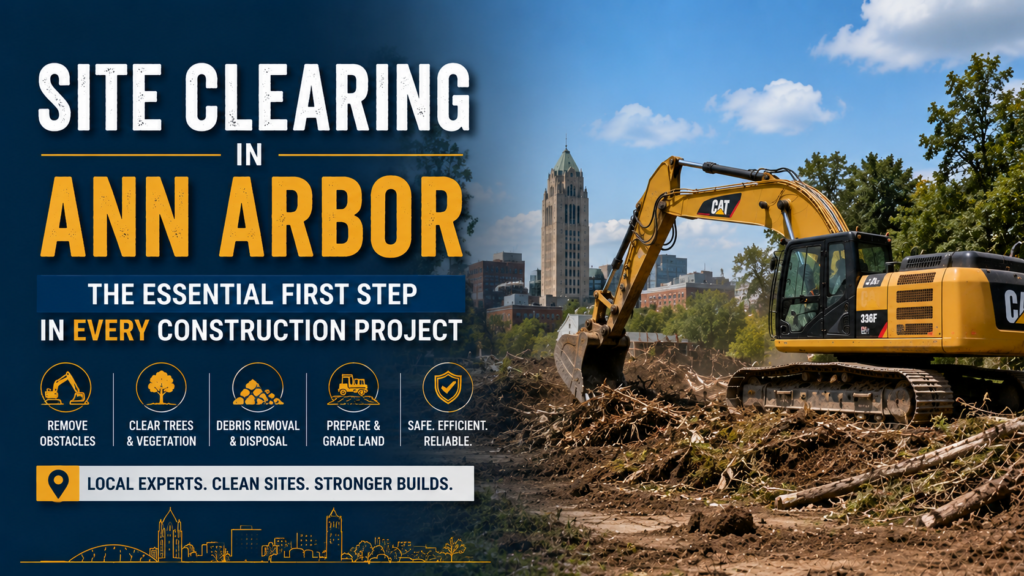
Every construction project begins with the land. Before a foundation can be poured, a building can be framed, or a road can be paved, the site must be cleared of everything that stands in the way: trees, brush, stumps, debris, old pavement, existing structures, and any other obstruction that would prevent safe and stable construction. This process Site Clearing Ann Arbor is one of the most important preparatory steps in any development project, and it is far more involved than simply running a bulldozer across a piece of ground.
In Ann Arbor and across Washtenaw County, site clearing is shaped by the specific landscape characteristics of Southeast Michigan: dense deciduous forests on undeveloped parcels, clay-heavy soils with complex drainage requirements, proximity to the Huron River and its watershed, and a regulatory environment that requires Soil Erosion and Sedimentation Control (SESC) permits for many clearing operations. Understanding what site clearing involves and why local expertise matters helps property owners and developers approach these projects with realistic expectations and sound plans.
What Is Site Clearing?
Site clearing is the process of removing all above-ground obstacles from a parcel of land to prepare it for construction or development. This encompasses the removal of trees and large vegetation, shrubs and brush, stumps, roots at or near the surface, rocks and boulders, old pavement and concrete, existing structures or their remains, and accumulated debris of any kind. The goal is to deliver a site that is clean, accessible, and ready for the next phase of work whether that is grading, excavation, foundation construction, or utility installation.
In the context of construction and development, site clearing is often the opening move in a larger site preparation sequence that includes grubbing (removing subsurface roots and organic material), grading (shaping the land to the required elevations and slopes), and utility installation. Each of these phases builds on the one before it, and the quality of the site clearing work directly affects the efficiency and quality of everything that follows.
Why Site Clearing Is More Than Just Cutting Trees
Many property owners underestimate the complexity of site clearing until they are in the middle of a project. On a wooded parcel and much of Washtenaw County’s undeveloped land is significantly wooded site clearing involves the controlled felling and removal of trees of varying sizes, the processing or disposal of felled material (logs, branches, and brush), stump removal or grinding, and the management of the enormous volume of organic material that even a modest clearing operation generates.
Heavy equipment is essential for any clearing project beyond a very small scale. Bulldozers can push over smaller trees and pile material for later processing. Excavators provide more precision and can dig out larger stumps. Skid steer loaders are useful for working in tighter spaces and handling material on smaller residential lots. Track-mounted mulchers and forestry heads can grind standing trees and brush directly into mulch, eliminating the need to haul bulky material off-site an approach that is both faster and more cost-effective for many applications.
The selection of clearing method depends on the size and type of vegetation, the intended use of the land after clearing, the site’s access and topography, and any environmental constraints. A skilled site clearing contractor evaluates all of these factors before selecting equipment and developing a clearing plan.
Michigan’s Regulatory Requirements for Site Clearing
In Michigan, land clearing operations that disturb more than one acre of ground, or that occur within 500 feet of a lake or stream, require a Soil Erosion and Sedimentation Control (SESC) permit under Part 91 of Michigan’s Natural Resources and Environmental Protection Act (NREPA). Given that Ann Arbor is situated within the Huron River watershed, many clearing projects in and around the city particularly those on larger parcels or those near the river and its tributaries are subject to this permitting requirement.
The SESC permit process involves submitting an erosion control plan that describes how the project site will be managed during and after clearing to prevent soil from washing into waterways and drainage systems. This typically includes installation of silt fences along downslope site boundaries, straw wattles or erosion control blankets on exposed slopes, stabilized construction entrances to prevent tracking mud onto public roads, and a schedule for re-establishing ground cover on disturbed areas as quickly as possible after clearing is complete.
Additionally, Ann Arbor’s City Code includes provisions regarding tree preservation in certain contexts, and the clearing of significant trees may be subject to review depending on project type and location. Property owners and developers planning clearing operations in Ann Arbor should verify applicable tree preservation requirements with the City’s Planning and Development Department before work begins.
Site Clearing for Residential Projects
In Ann Arbor and the surrounding communities of Washtenaw County, residential site clearing is most commonly required for new home construction on previously undeveloped lots, for the clearance of an existing home’s site in conjunction with house demolition, or for improvements to existing residential properties installing a new driveway, adding an outbuilding, creating a backyard clearing, or expanding a lawn area.
Residential clearing on smaller lots in established neighborhoods typically involves removing specific trees or shrubs, clearing a defined area for a structure, or removing vegetation from a previously unused portion of the property. This type of work is often performed with smaller equipment mini excavators, skid steers, and compact track loaders that can work in tight spaces without damaging adjacent landscaping, driveways, or neighboring property.
For new construction on undeveloped residential lots particularly those on the rural fringes of Washtenaw County where wooded properties are more common clearing may involve removing substantial tree cover across a larger area. On these projects, the choice between mechanical clearing and forestry mulching has meaningful practical implications. Mechanical clearing with a bulldozer is fast and highly effective for removing trees and large vegetation, but it significantly disturbs the soil and requires substantial debris management. Forestry mulching leaves a layer of wood chips on the ground that reduces erosion and decomposes naturally, but it is not appropriate for sites where slab foundations will be poured directly on the cleared ground (as stumps must be fully removed in those applications).
Site Clearing for Commercial and Development Projects
Commercial site clearing in Ann Arbor and Washtenaw County typically involves larger areas, heavier vegetation, and more complex site conditions than residential projects. The clearing of a commercial development site often also involves the removal of old pavement, existing structures, utility infrastructure, and other man-made features in addition to natural vegetation.
For commercial projects, site clearing is generally performed as part of a broader site development sequence managed by the project’s general contractor or site work contractor. The clearing must be phased to align with the project’s construction schedule: clearing too early means the site will be exposed to erosion for an extended period; clearing too late can delay the entire construction timeline.
Soil management is particularly important on commercial clearing projects. The topsoil layer the nutrient-rich upper few inches of soil is typically stripped and stockpiled during clearing for later use in landscaping or erosion control. The underlying subgrade must be assessed for its suitability as a building platform, and areas with poor soils may require additional grading, fill, or stabilization work before construction can proceed.
Ann Arbor’s Soil Conditions and Their Impact on Site Clearing
Washtenaw County’s soils are predominantly clay-based, a characteristic of the glacially deposited terrain throughout Southeast Michigan. Clay soils present specific challenges for site clearing operations. When saturated, clay becomes very soft and sticky, making it difficult for heavy equipment to maneuver without creating deep ruts and disturbing the soil structure. Site clearing in the spring when Michigan’s soils are often saturated from snowmelt and spring rains requires careful equipment selection and may need to be phased to allow drier conditions.
Clay soils also drain slowly, making proper grading and drainage planning essential after clearing is complete. A poorly graded cleared site in Ann Arbor’s clay-dominated soil environment will pond water, create access problems, and delay subsequent construction phases. An experienced site clearing contractor in this area designs their clearing operations with the subsequent grading and drainage work in mind, leaving the site in a condition that sets up the next phase for success.
Final Thoughts
Site clearing in Ann Arbor is the foundational step that enables every subsequent phase of construction. Done properly with appropriate equipment, regulatory compliance, erosion control, and attention to the specific soil and drainage conditions of Washtenaw County site clearing delivers a clean, stable, accessible platform that allows the rest of the project to proceed efficiently. Whether you are preparing a residential lot, a commercial development site, or a larger parcel for subdivision, understanding what site clearing involves and working with an experienced local contractor is the most reliable way to start your project on solid ground.